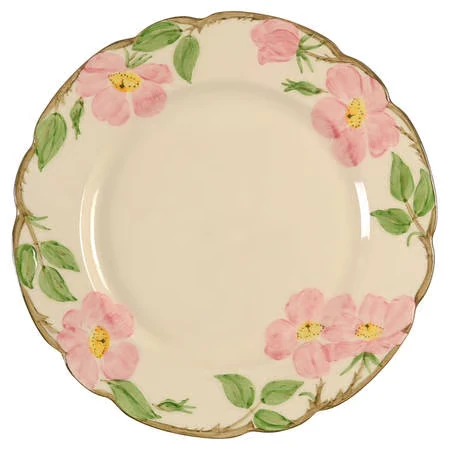
Desert Rose
Pink roses, green leaves and a softly shaped rim. Compare the backstamp as well as the decoration when adding to an existing setting.
Find Desert Rose on Amazon ↗View the catalogue referenceA favorite pattern. A missing plate. A collection to make your own. Explore the details that bring a vintage table together.
Three distinct starting points. The dates below describe the catalogue groups; they do not date an individual piece.
Pink roses, green leaves and a softly shaped rim. Compare the backstamp as well as the decoration when adding to an existing setting.
Find Desert Rose on Amazon ↗View the catalogue reference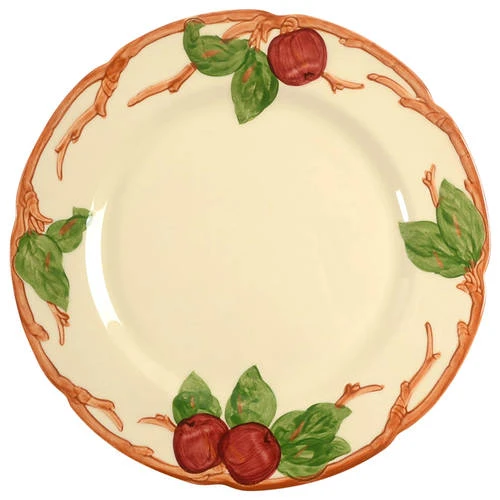
Red apples and green foliage give this pattern its familiar orchard character. Match the size, rim and underside of the piece you already own.
Find Apple on Amazon ↗View the catalogue reference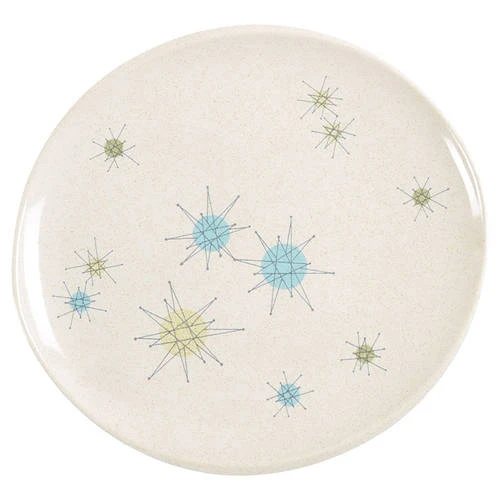
Aqua, green and yellow star motifs bring a distinctly mid-century look. Check the exact shape: the collection includes more than a simple round plate.
Find Starburst on Amazon ↗View the catalogue referencePaid links. As an Amazon Associate I earn from qualifying purchases. Catalogue photographs identify the pattern; request photographs of the actual item before buying vintage.
A useful replacement matches more than a pattern name. Keep these four details together when comparing listings.
Photograph the full decoration and a close view of the rim. Compare the placement of flowers, fruit or star motifs, not just the general color.
Photograph the complete underside in good light. Record every word, country mark and printed or impressed number without guessing missing letters.
Measure diameter, height and depth. Note whether the plate is coupe or rimmed, and whether a cup, saucer or lid has a matching seat.
Ask about chips, hairline cracks, crazing, staining and repairs. Compare prices only after you understand what condition each listing includes.
Production groups make a difference when you are matching a family collection. A country mark is a clue to compare, not a shortcut to authentication.
Replacements lists the USA-backstamp group for 1941–1984. Use this reference when your existing pieces carry a matching USA mark.
Compare the USA group →The separate England-and-Portugal-backstamp group is listed for 1985–2003. Compare the actual dimensions and decoration before combining pieces from different groups.
Compare this production group →Catalogue ranges are reference information, not a complete chronology of every Franciscan variant or a date certificate for an individual object.
“Plate” is not specific enough for a replacement. These catalogue measurements are examples from the Desert Rose USA group, not universal Franciscan sizes.
| Piece | Listed diameter | Check on yours |
|---|---|---|
| Dinner plate | 10⅝ in | Full width and rim profile |
| Luncheon plate | 9½ in | Do not substitute a smaller salad plate |
| Salad plate | 8 in | Decoration and rim shape |
| Bread & butter plate | 6⅜ in | Distinguish from a cup saucer |
| Saucer for flat cup | 5¾ in | Center well and matching cup base |
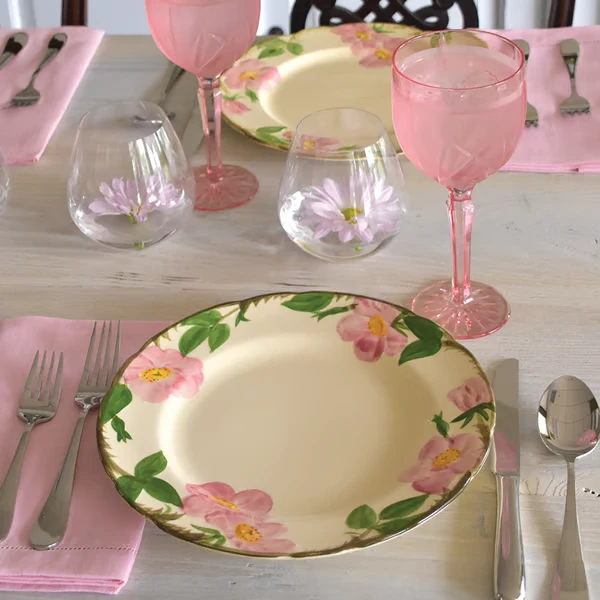
Request sharp photographs in natural light. A beautiful front view should be supported by views of the edge, underside and any disclosed damage.
Look for chips and rough edges. Ask for close views around cup handles, spouts and the ends of serving pieces.
Clarify visible crazing, scratches, discoloration and worn decoration. Ask whether a mark is on the surface or extends into the body.
Inspect the foot ring and underside. Ask directly about restoration, glued areas, repainting and any known previous repairs.
For a lid, cup or saucer, request the measurements of the mating surfaces. For a plate, ask about rocking or visible distortion on a flat surface.
Start with an inventory: dinner plates, small plates, bowls, cups, saucers and serving pieces. Mark what is missing and which pieces you actually want to use or display.
A large bundle is useful only when its contents fit that list. Count complete settings separately from extra saucers, lids and decorative pieces. A carefully matched pair of plates can be a better addition than a mixed box.
Explore Apple pieces ↗Care & keeping
Vintage pieces need care based on their actual material, finish and condition. If you cannot establish suitability for food use, enjoy the piece as a display object.
For pieces suitable for washing, use a gentle hand-washing routine and avoid abrasive tools. Support handles and projecting parts. Check any reliable piece-specific instructions before choosing a different method.
A familiar pattern name does not establish microwave, oven or dishwasher suitability. When trustworthy instructions for the exact piece are missing, avoid microwave heating and sudden temperature changes.
Separate delicate surfaces with a soft, clean layer where useful. Keep stacks low enough to handle comfortably and avoid placing heavy pieces on cups, handles or lids.
Save photographs of each backstamp and note where the piece came from, its measurements and any known repairs. This record helps with future replacements and passing the collection on.
Use this checklist while reviewing the seller’s listing. Your selections stay on this page only.
Open fragile parcels carefully and photograph any visible packaging damage. Compare the delivered pieces with the listing while the seller’s reporting and return windows are still open.
Check whether the recipient wants an exact replacement, a coordinating piece or a display object. Include the pattern name, known history and care information with the gift.
Repeat a color or shape to connect different patterns. Keep practical details consistent: usable plate area, bowl capacity and room for each guest still matter.
Start with clear photographs of the front, rim and backstamp. Compare the design and shape with a catalogue reference, then measure the piece. A familiar flower or fruit motif is only a starting point; the exact name and production group matter for a close match.
No. Replacements lists a separate Desert Rose group for England and Portugal backstamps. Compare the country mark, pattern and shape with the appropriate catalogue group rather than assuming every genuine Franciscan piece must carry a USA mark.
No. They describe a listed pattern or production group, not the manufacture date of your individual piece. Record the complete backstamp and ask a knowledgeable specialist when a precise date matters.
Do not assume an exact match. Compare dimensions, rim shape, background color, decoration and the backstamp. Pieces may coordinate at a table without being identical replacements.
Care depends on the exact piece, production period, decoration and condition. Do not infer modern appliance suitability from the pattern name alone. If reliable instructions are unavailable, avoid microwave use and choose gentle hand washing for a piece suitable for washing.
Ask for photographs of the actual item, including the rim, underside, foot ring and any damage. Clarify chips, cracks, glaze crazing, discoloration and repairs. A catalogue image shows a pattern; it does not document the seller’s individual piece.
Begin with an inventory of what you already own. Buy individual pieces when you need a precise replacement; compare a set by the useful pieces it adds. Count cups and saucers separately and check whether lids, serving pieces or damaged items are included in the total.
No. Age, appearance and a familiar pattern do not establish present-day food-use suitability. Check reliable information for the particular piece and its condition. If suitability cannot be established, reserve it for display rather than assuming it is appropriate for meals.
Start with the design you love, then find the piece that fits.
Explore the patterns →Pattern photographs, catalogue date ranges and the specific Desert Rose dimensions reference Replacements: Desert Rose USA · Apple USA · Starburst · Desert Rose England & Portugal. Photographs identify a design and do not certify the condition or authenticity of an individual seller’s item. Reviewed October 13, 2026.
As an Amazon Associate I earn from qualifying purchases. About paid links.